




-
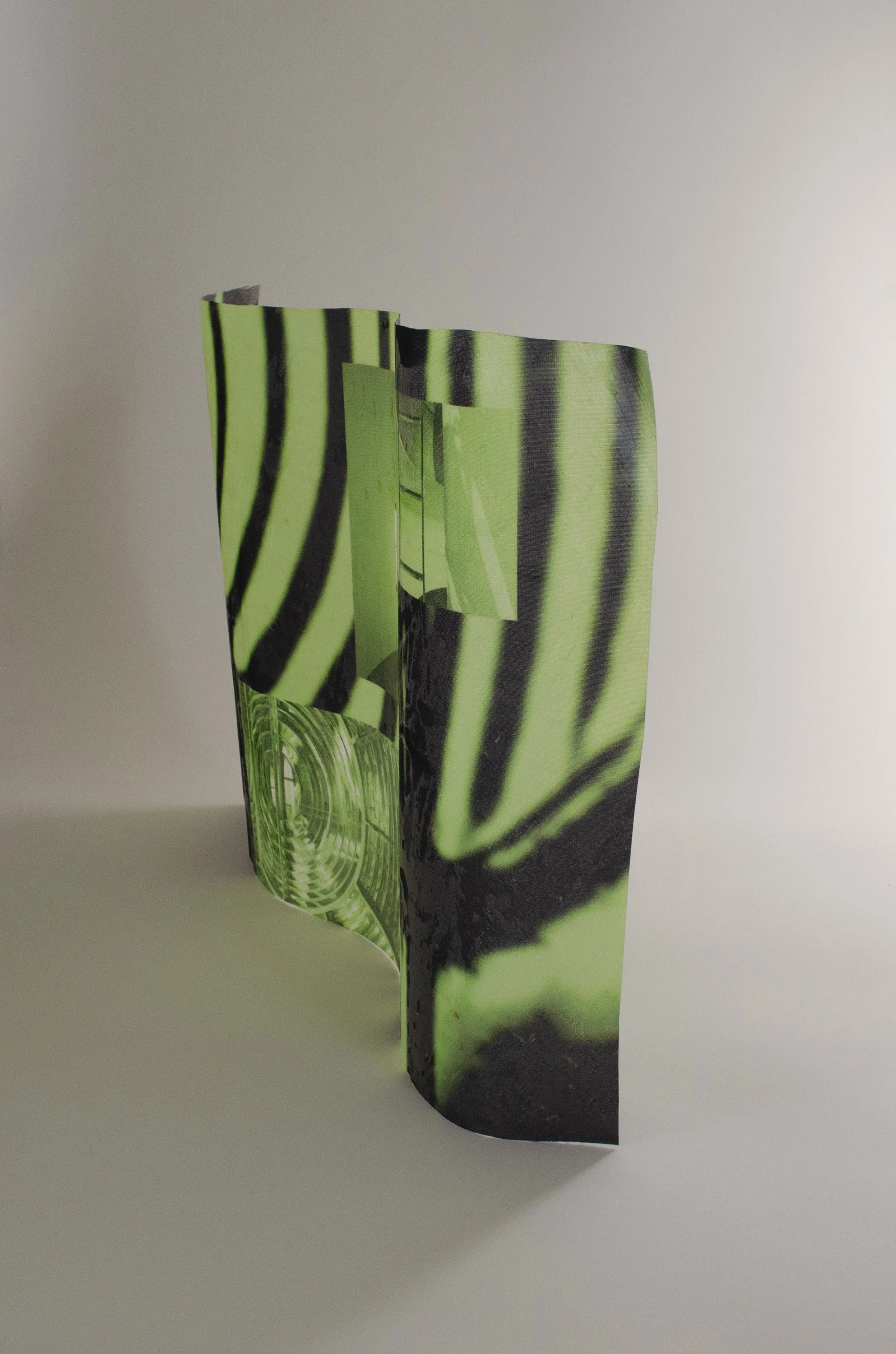
Photo prints on fabric with resin and fiberglass
Dimensions variable, approximately 2 x 3 feet (0.6 x 0.9 meters)
2018–2019 -
Quantum mechanics arguably found its first expression in nineteenth-century France through the inventions of Augustin-Jean Fresnel, a civil engineer who drilled a hole in the wall of his room over which he suspended a drop of honey and a thin wire to prove the wave theory of light and take measurements of the fringes and bands of diffraction. This led to the development of the Fresnel lens, which was used to extend the throw of a lighthouse. One could say that Fresnel’s invention extended the horizon for sailors and merchant-marines traveling overseas; the bright lights were visible in the atmosphere even when the lighthouse itself was out of sight.
During the years Fresnel devoted to proving the wave theory of light, he was lambasted as part of a ridiculed corner of scientific thought known as the Undulationists. The Undulationist theory led quantum science to less intuitive and more entangled theories of the universe operating at both micro and macro levels of matter and energy. These reformulations disturb a naturalistic view of reality, in which illusionistic space and classical perspective have a reliable and fundamentally Cartesian steadiness.
This series of resin-coated fabric prints takes the form of undulating photographic sculptures, on which images of lighthouse lenses, titanium dioxide mines, and the constructive and destructive interference patterns of light combine. The flexible form of each sculpture morphs over time, while their curved forms combine discrete, photographed moments into a continuum much like spliced reels of film.