

Word Pictures: Contemporary Calligrammes and Visual TypographyBy Christopher Squier
A Reflection
on Word Pictures and Poem Objects
at Amos Eno Gallery
May 18 – June 27, 2026
One of the foremost poets and critics of the early twentieth century avant-garde, Guillaume Apollinaire was fêted for his lucid entanglement of word and image. Crafting poetry dense with visuals, his work was marked by the experimental ethos of his time, still unfazed by the coming Return to Order of the 1920s. Apollinaire was feverishly involved in art criticism and artistic discourse, reviewing many of the Cubists’ exhibitions in his journal Les Soirées de Paris in scintillating prose, while concurrently transferring the Cubists’ methods of fragmentation and collage to poetic syntax through his early “conversation poems.”
These experimental works collated multiple perspectives, forms of address, and rapid-fire snippets of conversation in disorienting glimpses of the intellectual cafe culture of the time. However, it was the concept of simultaneity borrowed from artists Robert and Sonia Delaunay’s vivid Orphist paintings in the years leading up to World War I which provided the impetus for Apollinaire’s major breakthrough, a “simultanist” reflection on the overlapping sphere of communication proffered by modern technologies, be it semaphore, the telegram, the telephone, or the gramophone, as well as developing forms of travel including the expansion of the railroad and the advent of commercial aviation.
In poems like “Les Fenêtres,” “Arbres,” and “Lundi rue Christine,” Apollinaire developed these ideas into a telegraphic style of writing that provided instantaneous glimpses of life, ricocheting between seemingly unrelated quotations, observations, conversational fragments, and onomatopoetic sounds. Published under the title Ondes (referring to radio waves), these poems gave the impression of conflicting realities and the buzz of overheard conversation in a busy room, of various realities shuttling through shared telegraph cables, and of radio transmissions filling the empty air in cacophonous syncopation. At the same time, Apollinaire made the decision to forego punctuation, flaunting the strict rules of the French poetic establishment and allowing each simultaneous impression to run directly into the next without break or pause.
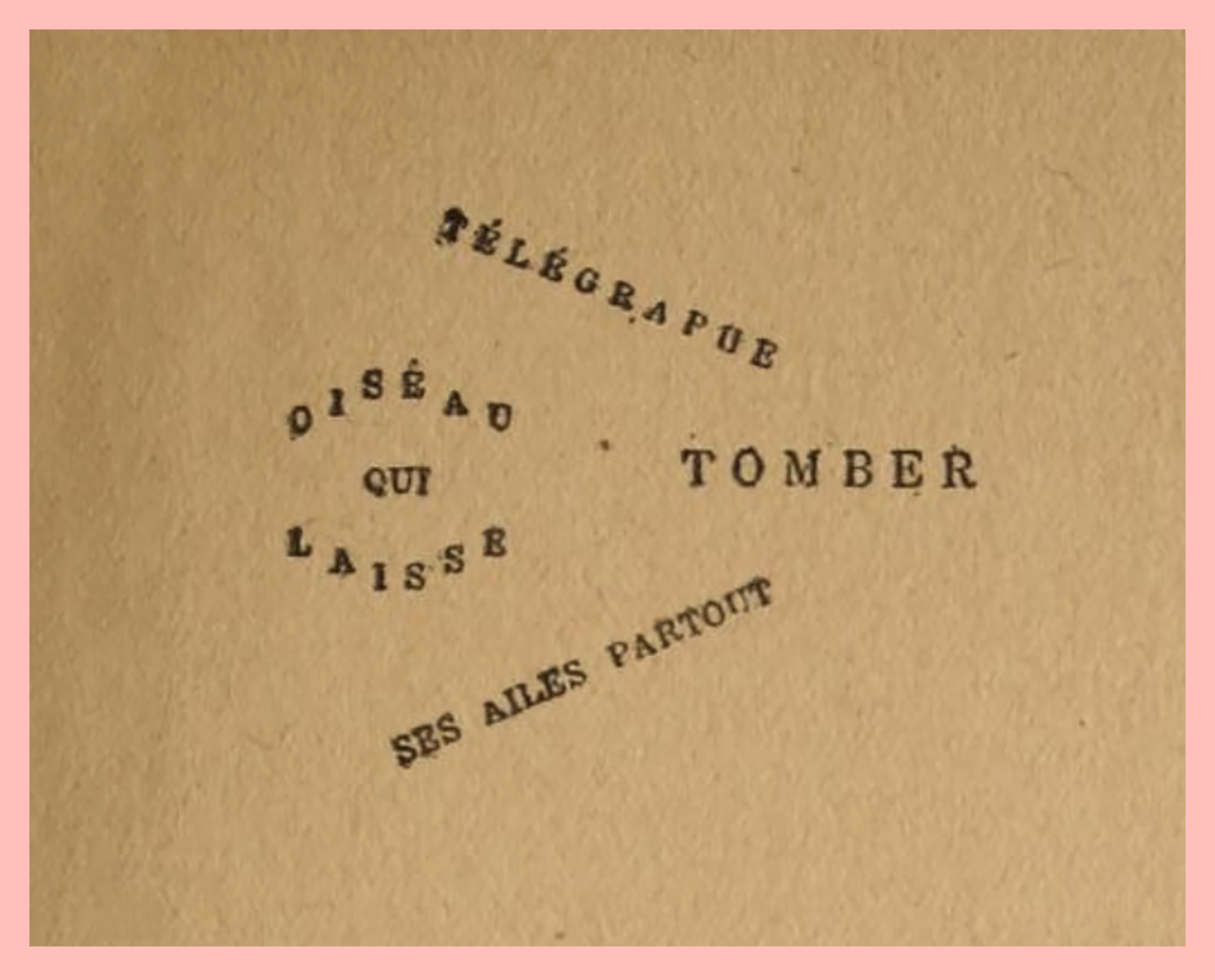
Apollinaire’s poems, published posthumously following the Armistice in 1918, embrace the capaciousness of the empty page with letters and phrases arranged to depict objects or lines of motion, spiralling out like radio signals, trailing across the page as raindrops, or carefully aligned as if they were constellations of stars. Technologies of communication recur throughout. A calligramme in the shape of a swallow in flight reads, “Telegraph: bird which drops its wings everywhere.” He provided a postscript to his collection of calligrammes, “Poems of Peace and War,” underlining the elegiac and lyrical tone of many of these texts. “The rain so tender, the rain so sweet / The long trenches where you walk / Farewell to the artillery dugouts,” he offers in elongated bars of lettering that mirror rain pouring from clouds as well as the linear structure of the trenches themselves.
These poignant concatenations of language-as-image preface and frame the exhibition Word Pictures and Poem Objects, which centers the work of artists thinking through the visual capacity of the written word: its structure and breaks, its punctuation and sonics, its distribution within various modes of publication and readership, and its elisions of meaning. In gathering these artworks together, I was interested in how artists today might refigure the written word as a decisive moment within the production of narrative, before the possibilities of a phrase are foreclosed by literalism or assumption. How do artists open up room for doubt, doubled meanings, revision, or ambiguity within otherwise matter-of-fact and straightforward declarations?
I’ve highlighted a selection of the exhibiting artists below, and you can view the full exhibition on Artsy, linked here. The exhibition officially ended this past week, but the works will remain online (and on sale) for a few more weeks.

A number of the selected artworks play directly with the format of the calligramme and concrete poem, allowing the chain of a word or phrase to roleplay a related action while existing outside the structure of the lined page.
For Carolina Magis Weinberg, punctuation and diacritical marks act as a tone or accent which inflects language with the fullness of the speaker’s self. As a linguistic phenomenon, the accent — both spoken and written — produces the atmosphere within which words operate; it affects how we perceive a message and carries with it unconscious association and assumptions.
Weinberg has used the accent throughout her work to consider various modalities of reception, often using confetti as a signifier of the visual excess and subtle shifts of meaning within the Spanish language. In her works for Word Pictures and Poem Objects, she asks what happens when the signifier and the signified converge: when written words and letters attempt to enact their meaning. Through a playful arrangement of punctuation marks including parentheses and slashes, she completes the meaning of words like FIRE, WIND, SNOW, and RAIN, restoring a tangible descriptive sense, allowing words to surpass sound and become images.
Similarly, in her artist book Selected Whether Reports, Weinberg examines the cartographic diagrams of weather reports to offer an index of punctuation marks, arrows, and typewritten symbols that calculate the probability — the whether — of various weather events. These found poems explore “the poetics of possibility rather than the certainty of truth coming from observation,” as she writes, and offer a diagrammatic landscape in place of a representative one; we can substitute an abstract weather map in place of a visual painting or photographic document and begin to see the world in terms of forecast and prediction, chance and probability. In parallel, her photograph Reiterate captures a line of skywriting drifting serenely between palm fronds and a bright burst of sunlight. The skywriting spells out the phrase “beautiful cloud,” substituting a fake cloud for the reality of one and producing a contemporary mirage in the process.
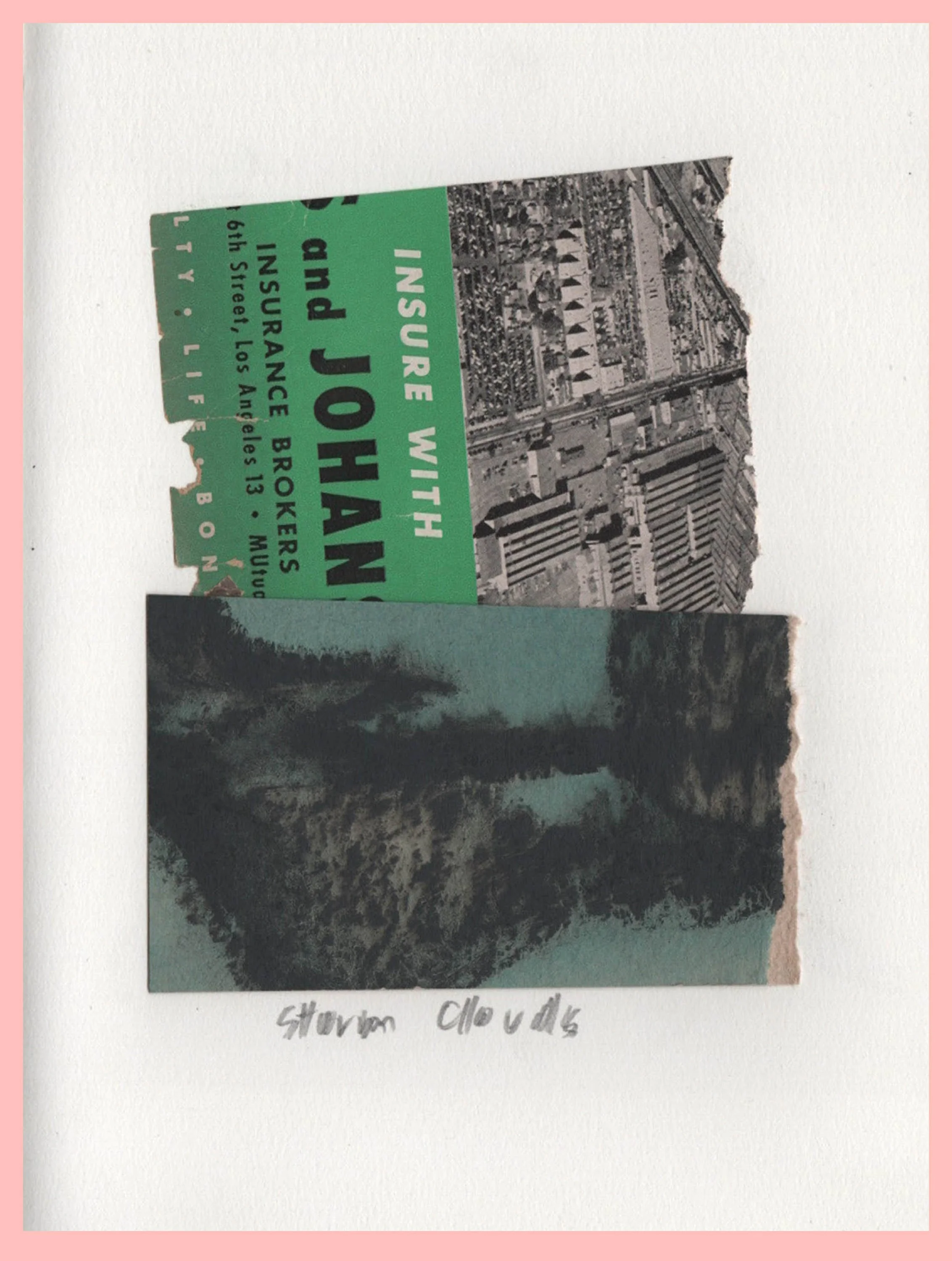
Dana Pierfelice addresses the fury of an oncoming storm with imagery cut from different sources; her elegant collage draws together the abstracted blur of an imminent weather event intercut with a cityscape culled from an insurance advertisement. The ad, proffering a financial model to hedge against unforeseen tragedy, raises a threat which Pierfelice makes visible yet contains. We see the storm clouds brushing against the torn edge of paper, barely held at bay, and imagine the deluge. However, in the storm’s small scale, a mere scrap of paper, and in its placement, inverted beneath the city as though having already passed by, its inky smudge is contained like a memory or footnote. The doubling of the title offers a tremor of vibrations, as though the image itself were briefly shaken by the storm. As Pierfelice writes, “Ultimately, these works are a negotiation between clarity and ambiguity. Much like poetry, there are not fixed meanings in these works, but a slow unfolding through attention and association.”
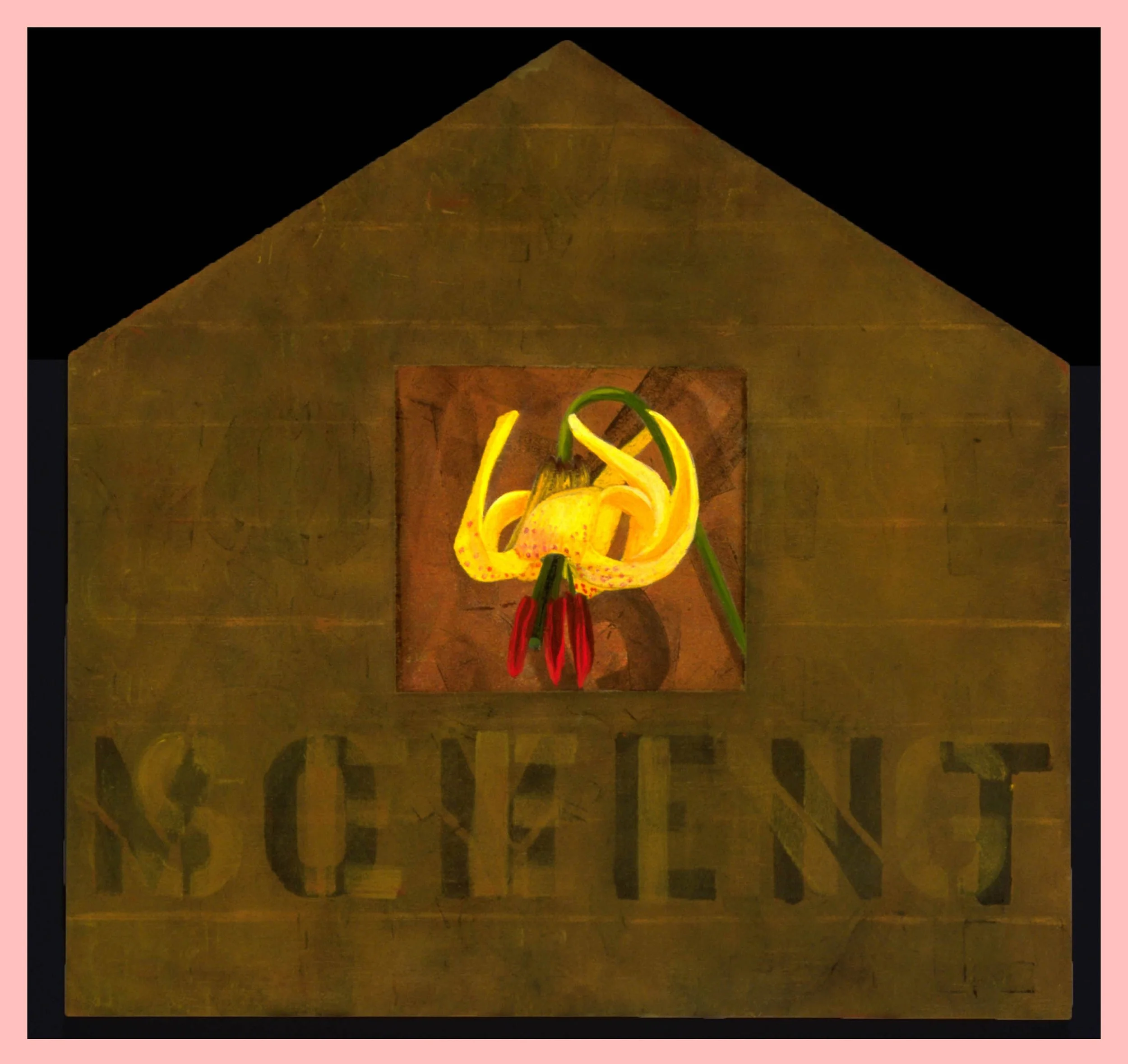
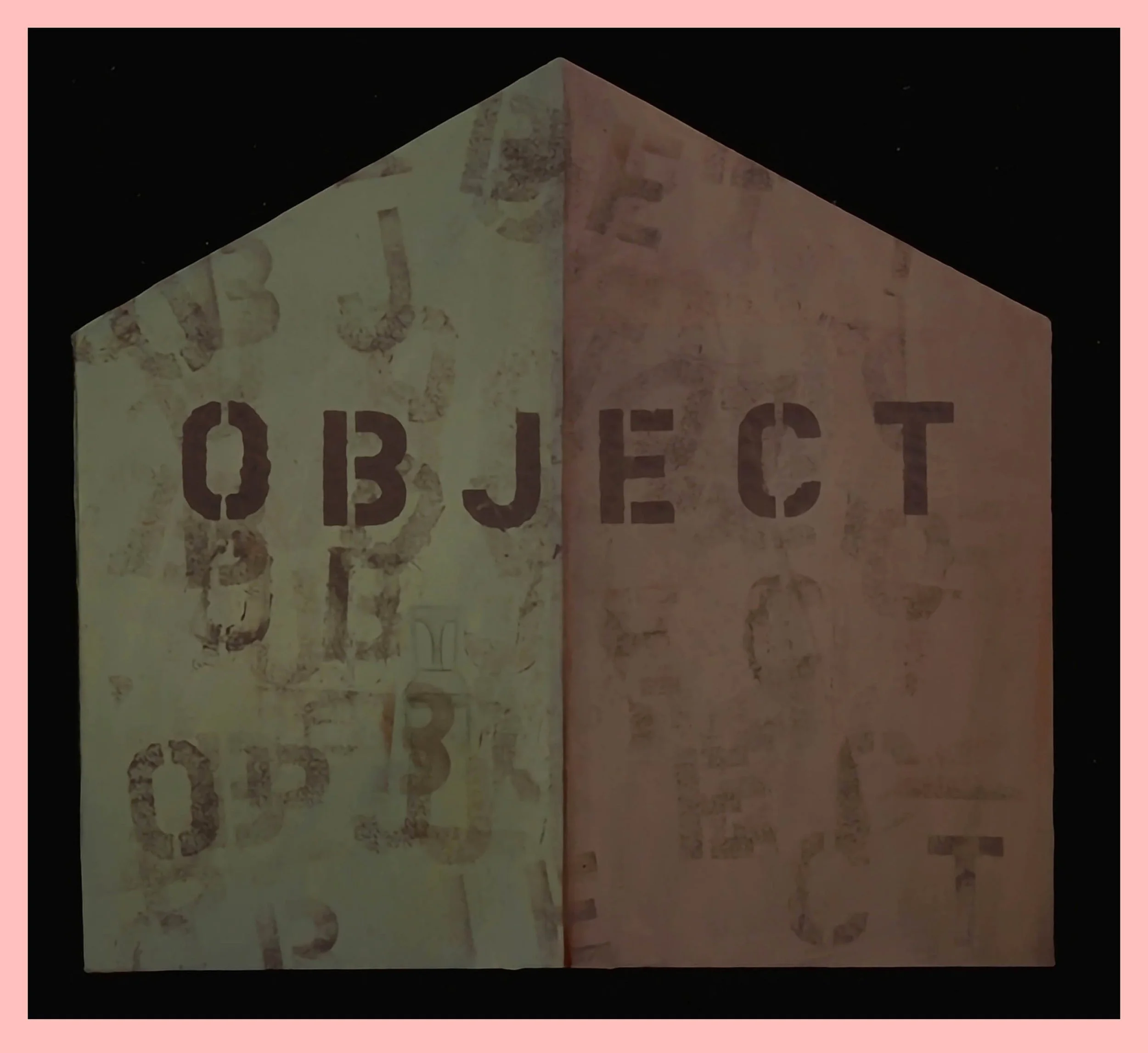
Carol Ladewig’s House series (1994–2017) builds a structure around language, asking each combination of letters to hold its own on the canvas. As she writes, “These painted objects bring language into material form through stenciled words, symbolic imagery, and layered surfaces. The house is portrayed as a psychic space: a container for memory, interiority, and the unstable relationship between words, images, and lived experience … These words are straightforward and familiar, but I am interested in how unstable they become when they enter the space of a painting.”
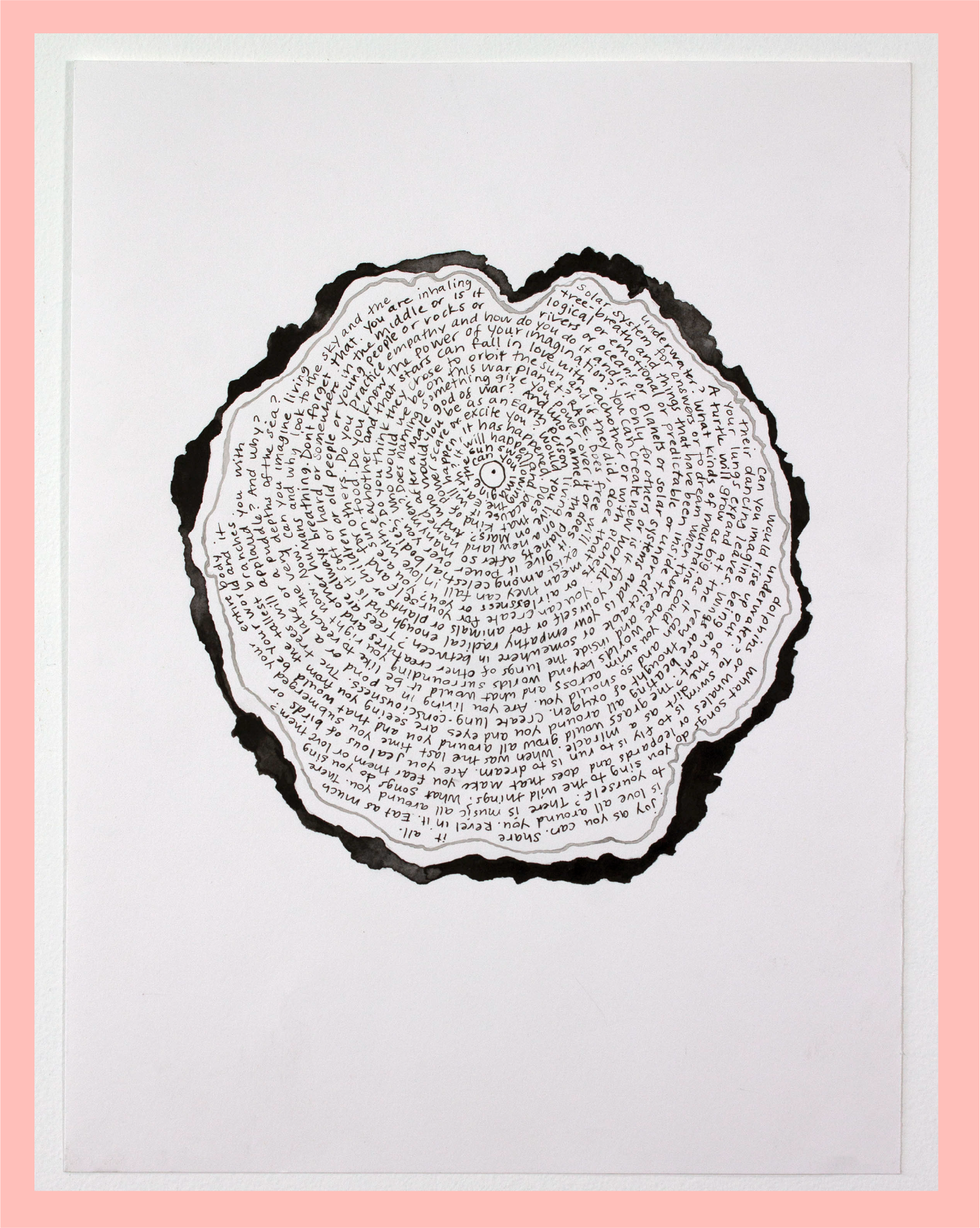
Kathy Sirico, a multi-hyphenate textile artist, sculptor, abstract painter, and poet, is interested in the impacts of climate change in the high Arctic Archipelago of Svalbard. She writes poetry following the structural logic of natural forms and processes. Tree rings which expand through wet and dry seasons year after year offer a spiralling compositional space for speculation on other lifeforms and their perspectives, as do smaller phenomenon: ants wending their way through the immense beams of grass around them, a world unto itself; or the sea floor, which resembles mountains; the planets, their orbits similarly demarcating circular arcs around a central axis and bound to the sun — is this circling motion a lack of free will, she asks, or perhaps an act of love?
Other calligramme-like poems stream across the page like the flow of a river current or intersect like the vectors of astronomical bodies. By mirroring natural formations rather than traditional poetic structures (the sonnet, ballad, or haiku, for example), she allows longer spans of time into the poem as a way of articulating an awareness of the environment.
“Can you imagine the sun swallowing the Earth? It will happen,” Sirico writes. “Do you practice empathy and how do you do it and is it only for others or is it for yourself or for animals or plants or children or old people or young people or rocks or rivers or oceans or planets or solar systems and is your empathy radical enough and is it soft or hard or somewhere in the middle or is it logical or emotional or predictable or unpredictable or somewhere in between?”
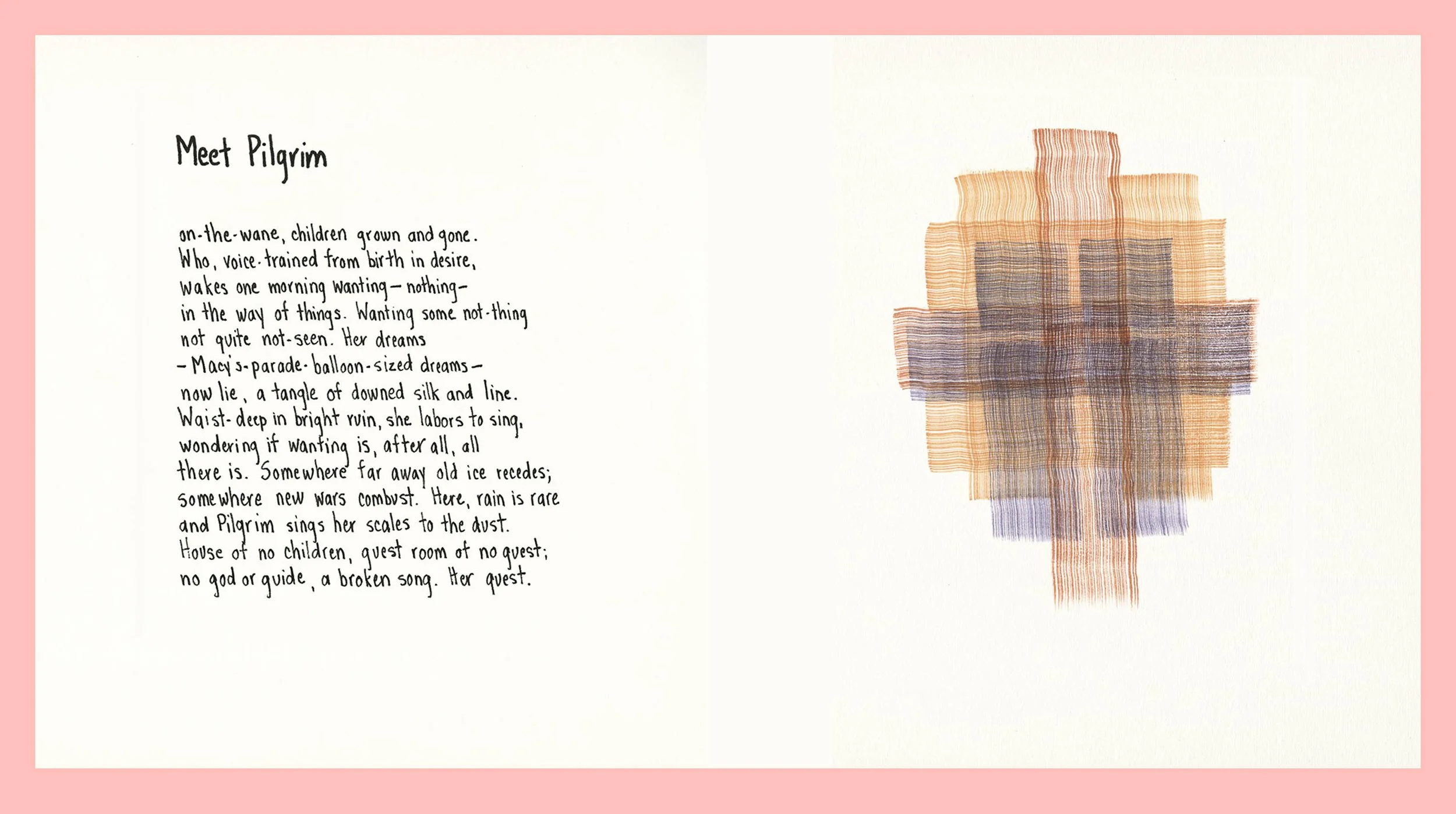
Lorna Stevens similarly plays on the structural form of poetry in her broadsides from Paradise Drive, an artist book created in conversation with the poet Rebecca Foust. Stevens’ visuals draw on the sonnet’s fourteen-line structure, advancing a visual language of fourteen watercolor brushstrokes, each responding to the subject and tone of its accompanying poem. In these works, Stevens writes, “Text and image share a unified field, resisting illustration or explanation. Instead, they operate in parallel, inviting viewers to move between reading and looking. The handwritten text emphasizes the material presence of language, while the paintings—reduced to essential marks—echo the compression of the sonnet form.”
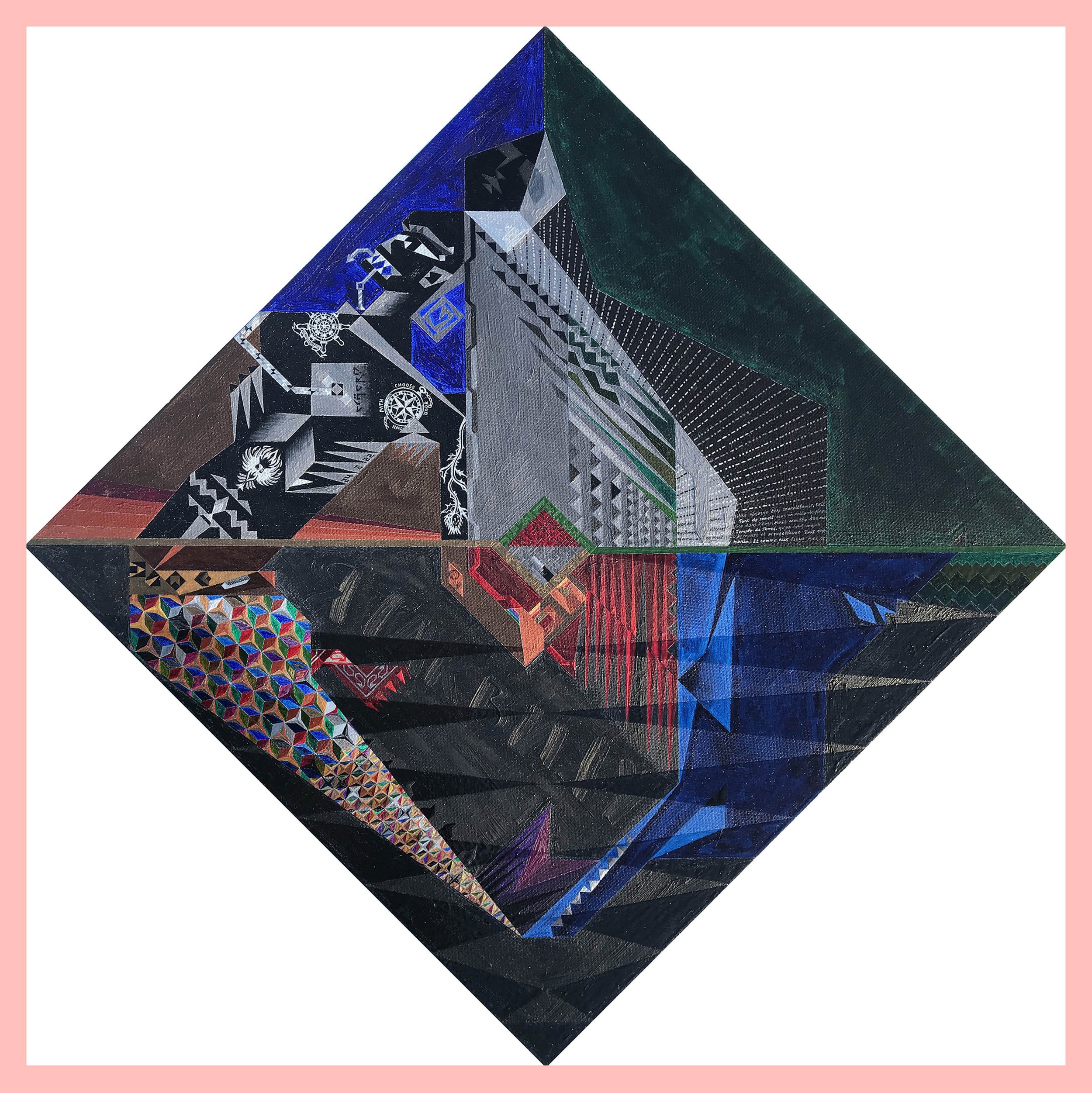
Farhad Nikfam’s painting Le Rayon Vert is ostensibly based on observation, recounting a rare atmospheric phenomenon known as the green ray which occurs around sunrise or sunset. As the sun’s light passes through the atmosphere, it separates into the various colors of the spectrum, producing a flash or ray of green that is briefly visible for a matter of seconds. Nikfam’s work expands on this personal experience and its spiritual dimensions through a diamond-shaped composition subdivided by a horizon line into sky and ground (or sea). Various linguistic codes are transposed onto the canvas, including sailor’s tattoos as well as Paul Valery’s poem “Le Cimetière marin" (The Graveyard by the Sea), which the artist writes in French following by a translation into Morse code.
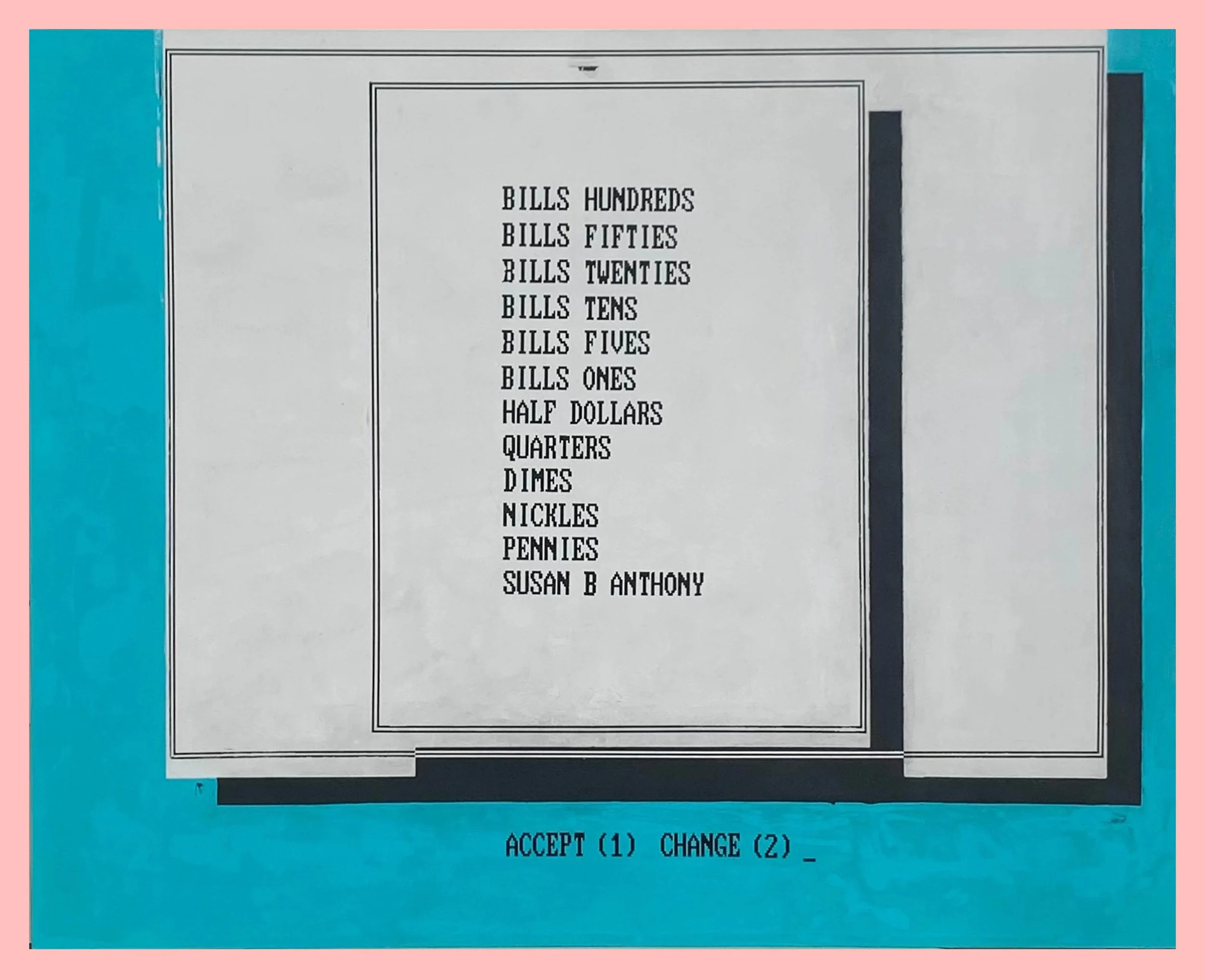
Alice Combs’ acrylic painting on panel Accounting takes a more technological tack, transposing the glowing screen of a retail store’s interface which lists various denominations of currency in diminishing value until it lands at last on the Susan B. Anthony dollar, which has been displaced from its logical order above the half dollar. The point of sale system and its computer code offer little room for correction, embodying a seemingly cynical position in relation to the coin’s suffragette reference as it asks a question familiar to anyone struggling with an intransigent hegemonic system: accept or change?
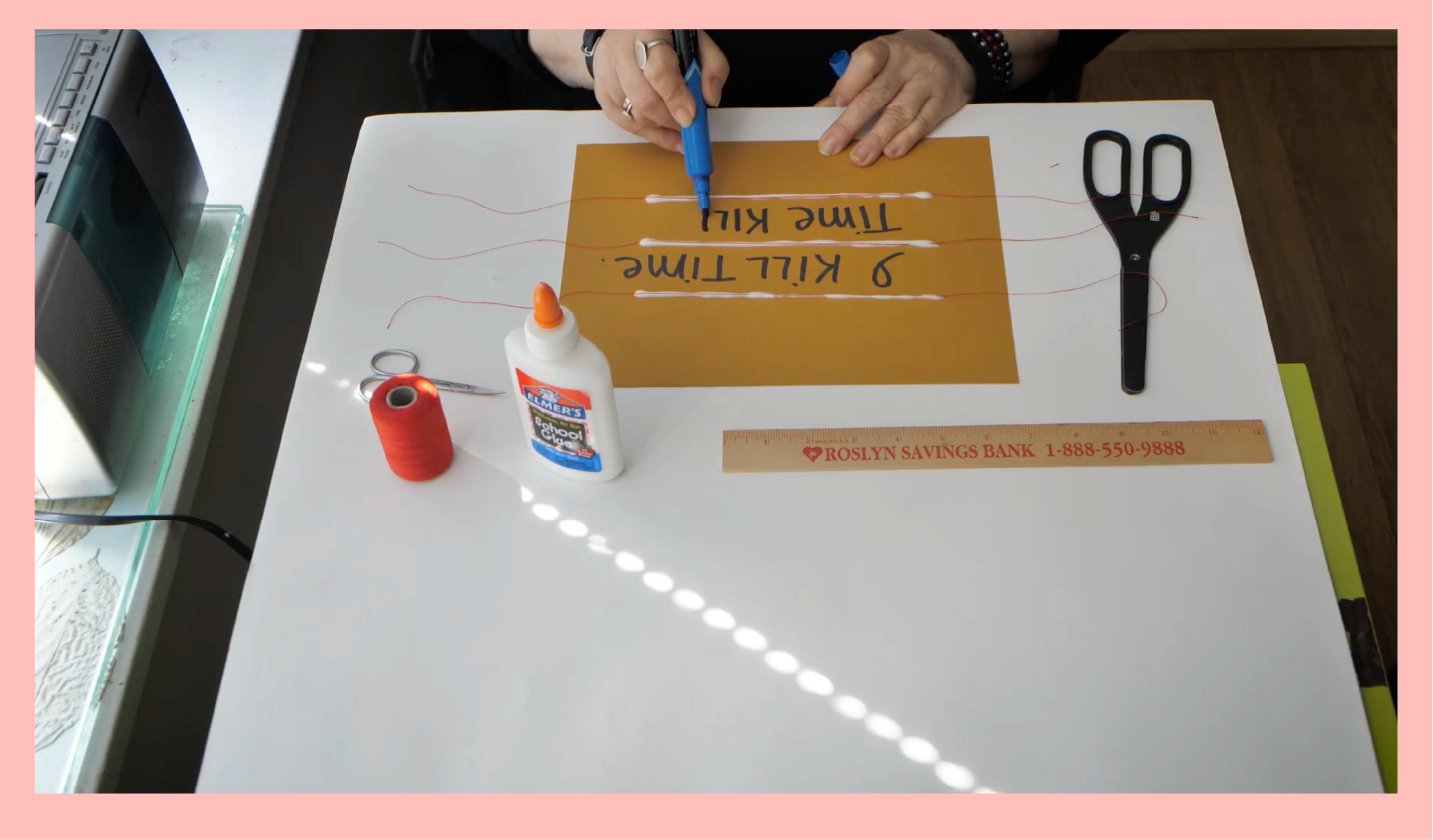
In Marina Tëmkina’s video performance I KILL TIME, the poet-artist is seen slowly developing a work on paper which combines the poetic inversion “I Kill Time / Time Kills Me” with thin red lengths of thread. Tëmkina stretches these threads along a line of glue that stops their movement, while letting their ends hang freely as though “elements of incomplete pieces of fabric or unfinished stories.” As the work develops, its elements take on variously humorous and mournful tones.
Tëmkina writes, “The meaning of this image is in between creative and existential freedom and the unavoidable limits of this individual freedom. The performance deals with the process of making art in time and its limits, repetition, pattern, the unnoticeable labor women, and the finality of life.”
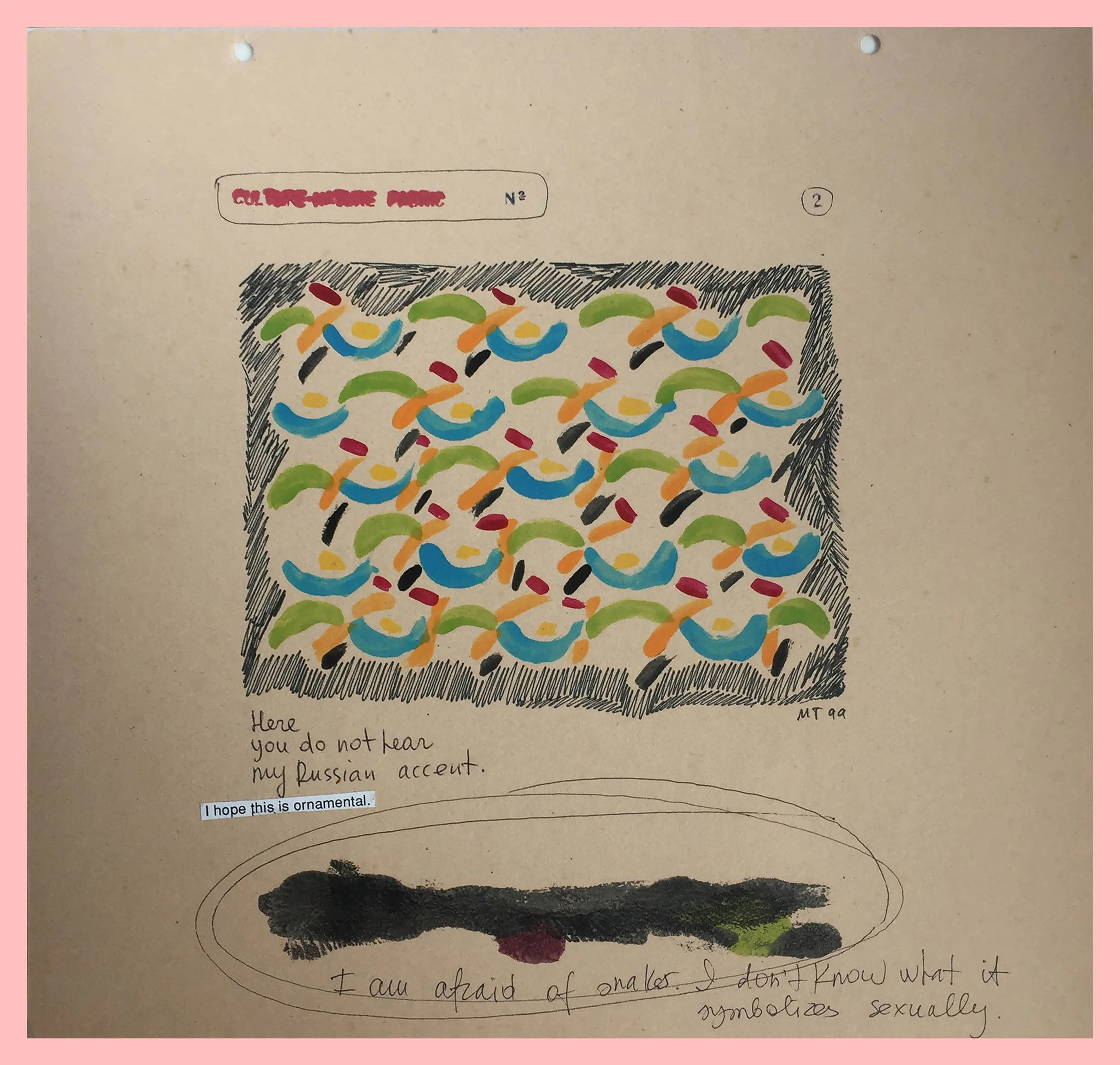
The video work echoes an earlier work from 1999 titled Culture-Nature Fabric, which Tëmkina crafted on photo album paper using pen, ink, nail polish, and collaged pieces of text. The wry, often poignant, observations comment on life from Tëmkina’s perspective as a Russian-Jewish feminist immigrant living in New York in the decade following the disbanding of the Soviet Union. Each panel of the series depicts a patterned textile or carpet hanging on a wall, under which an ominous ink blot undulates (Tëmkina also maintains a practice as a psychotherapist, specializing in refugee resettlement, cultural differences, and gender and identity). Accompanying sentences describe fear, sickness, conformity, and cultural standards of beauty and taste or tastelessness.
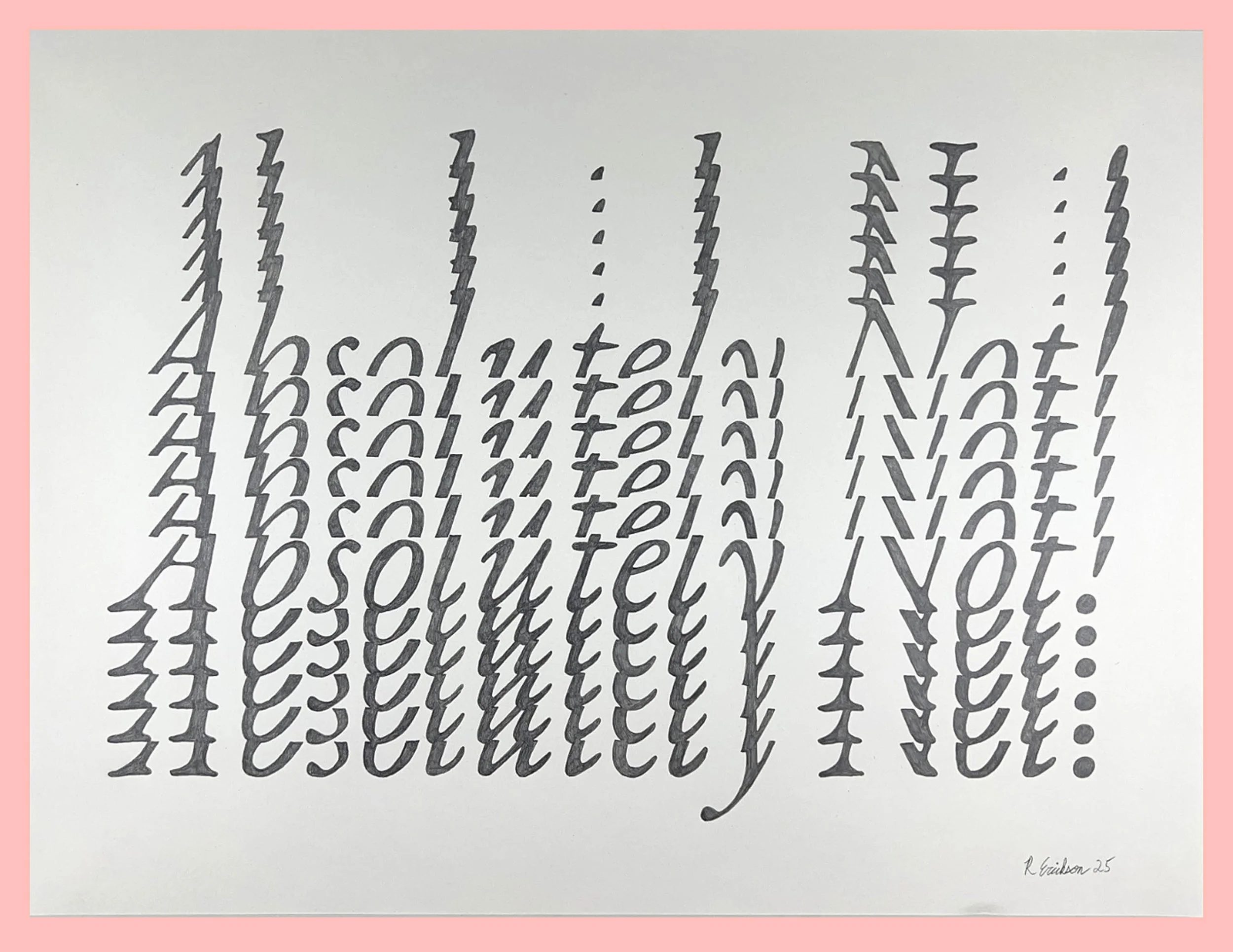
Ryan Erickson unpicks the certainty of declarative language and terminal utterances through drawings which fracture and refract the smooth edges of a word. Erickson’s drawings take as their subject the most insistent vocabulary available: “yes,” “no,” and “absolutely not.” These are phrases that perform the end of argument, words that declare, without remainder, a position. His drawings begin with that declaration and then systematically undermine it through fragmentation: each word is fractured and refracted across the pictorial surface in pencil, broken, distributed, reiterated until the act of reading becomes inseparable from the act of looking. What should resolve into meaning instead opens into pattern. This is not concrete poetry’s celebration of the letter as form, nor is it the lyric overflow of gestural inscription. As Erickson writes, “What interests me is not the beauty of language made visible, but the exposure of how certainty is performed.”
View these and other works in the exhibition Word Pictures and Poem Objects, online at Artsy.net via Amos Eno Gallery
Image captions:
[1] Carol Ladewig, Seeing Moment, 2000. Oil, resin, and wax on wood panel. 19 1/2 × 19 1/2 × 2 inches
[2] Guillaume Apollinaire, “Télégraphe”
[3] Carolina Magis Weinberg, FIRE / WIND / RAIN / SNOW, 2017. Laser-cut black cardstock. 18 × 10 inches. Edition of 2
[4] Dana Pierfelice, storm clouds, 2026. Ink drawing and found material on paper. 8 × 6 inches
[5] Carol Ladewig, Object, 1999. Oil, resin, and wax on wood panel. 16 × 16 × 2 inches
[6] Kathy Sirico, Can You Imagine, 2022. Ink on paper. 12 × 9 inches
[7] Lorna Stevens, Meet Pilgrim, 2020. Watercolor and ink on Saunders Waterford paper. 9 × 17 inches
[8] Farhad Nikfam, Le Rayon vert, 2024. Oil and latex house paint on canvas. 28 × 28 inches
[9] Alice Combs, Accounting, 2024. Acrylic on wood. 24 × 30 inches
[10] Marina Tëmkina, I KILL TIME, 2026. Video: H.264 format; performance of making a drawing with text on paper with thread, glue, and a marker; duration: 00:05:47; resolution: 3,840 x 2,160 px
[11] Marina Tëmkina, Culture-Nature Fabric: I Hope This Is Ornamental, 1999. Mixed-media drawing with pen, red ink, nail polish, and paper collage on album paper. 11 5/8 × 12 1/4 inches
[12] Ryan Erickson, Absolutely Not!, 2026. Pencil on paper. 18 × 24 inches


