

EVERY POINT IS A STARText by Christopher Squier
May 15, 2026

Ptolemy
presents Evan Brownstein
in Travelogue Hum
May 15 – June 7, 2026
When we name things simply, with words preceding their meaning, a cosmic narration takes place. Does the discovery of origins remove the dust? The horizon’s shimmering slows down all other perceptions. It reminds me of a childhood of emptiness which seems to have taken me near the beginnings of space and time.
– Etel Adnan, Shifting the Silence
When we look at stars through a telescope, something frustratingly mundane occurs. Their light, having traveled immense distances, doesn’t resolve into anything much. Perhaps it’s a smudgy pinprick or a double image if, say, the telescope lenses aren’t lined up quite right. Or perhaps some flares and deformations occur as the image resolves – but the pointed lines radiating from the star are produced by chance through the blur and refraction of light ricocheting through a turbulent atmosphere, glancing erratically off humid molecules of oxygen and nitrogen, or dispersing haphazardly on the lens of the photo apparatus. There’s no perfect alignment, no sacred geometry. In stargazing, we peer at the universe looking for order and an ancient light arrives without fanfare: a quiet messenger across time and distance. We might say the stars have lost their charge.
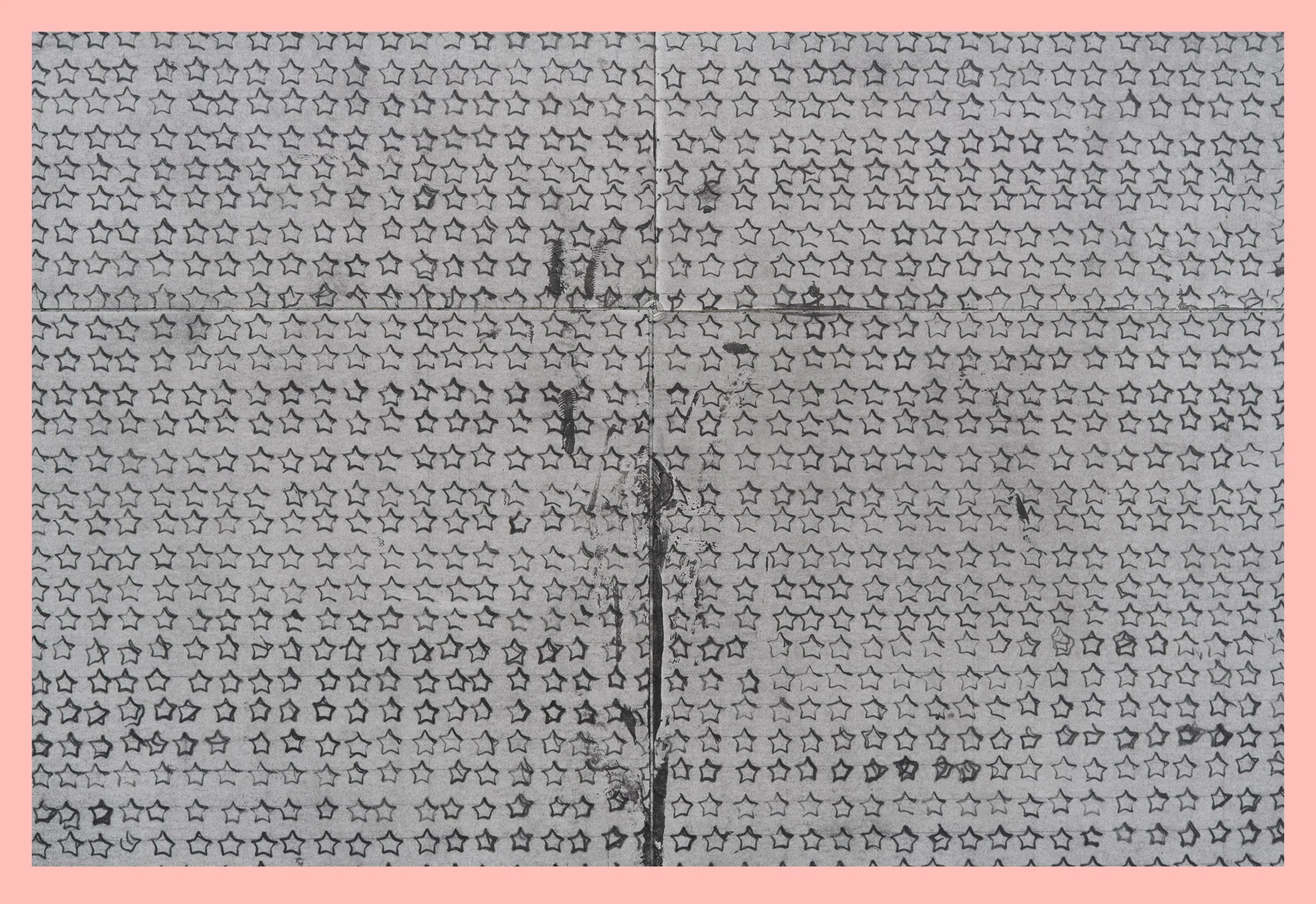
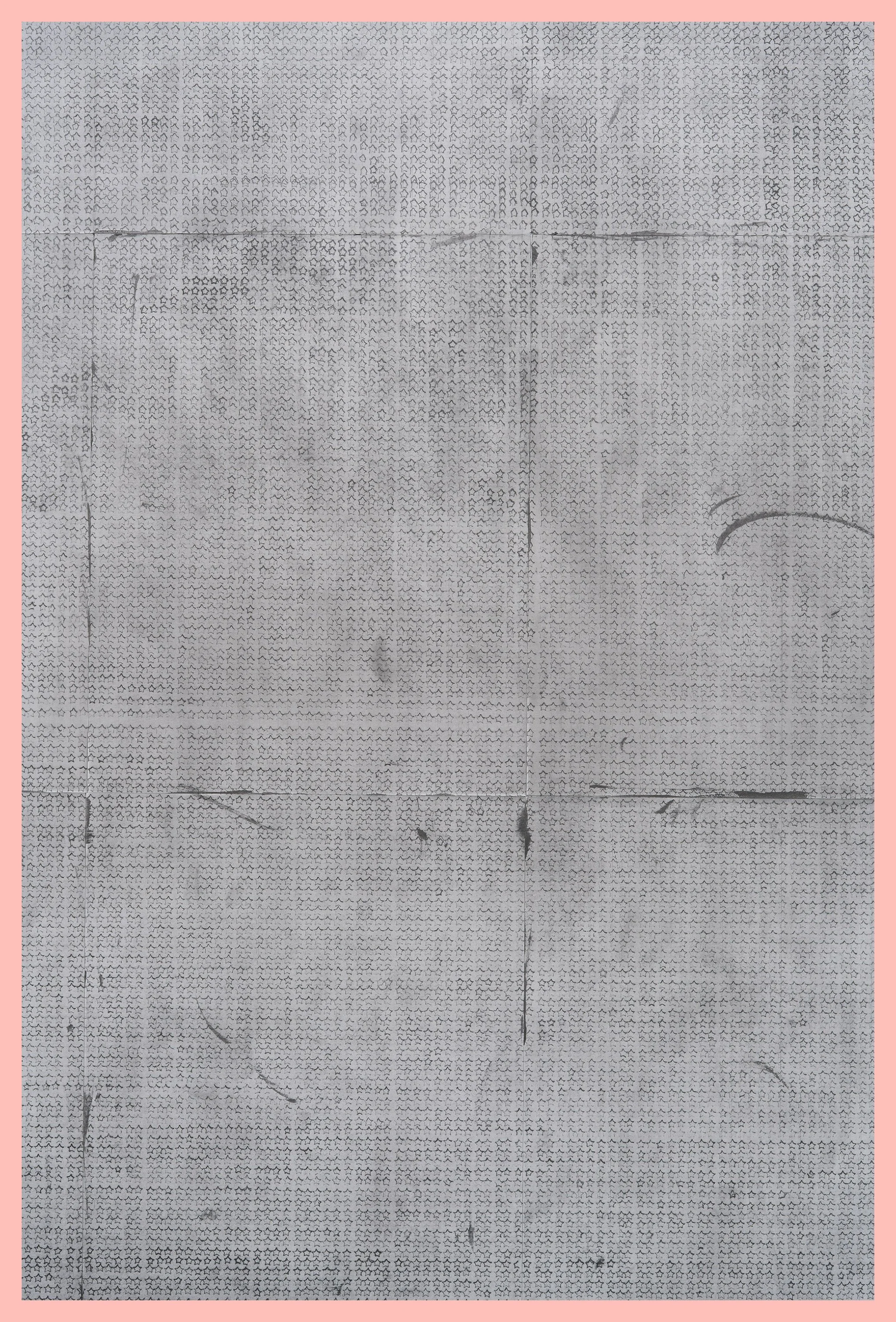
For Evan Brownstein’s presentation of new works at Ptolemy, he set out to do the opposite, asking himself, “How do I make a charged object?” In his shimmering graphite drawings on paper, the star-specked sky buzzes and vibrates, framed against the tangible and commonplace matter of eleven by fourteens. His austerely stenciled marks rest upon a poor and flat surface, seemingly without depth, secrets, or reserves, which reveals itself to the attentive viewer. Each drawn star might be trivial on its own, a web of ten lines tossed together like a game of pick-up sticks that have fallen into alignment. As they accumulate on the page, star after star, row upon row, we perceive the endless rank and file of gridded stars. Their internal sense of order belies the mystery and randomness of their referents: scorching masses of hydrogen and helium arrayed across the universe, pinpricks of light traveling through almost infinite stretches of empty space to align as asterisms seen from Earth.
In his essay “Thinking Dark Anew,” the mathematician and astrophysicist Reza Tavakol theorizes the concept of ‘relative darkness,’ in which no place within our universe is truly or inescapably dark. The vacuum of space is always pulsing with wavelengths of energy, visible and otherwise, and darkness must be understood for each species according to the sensitivities of their vision. In this way, it is only human perception’s limited scope which permits us the moment of reprieve that relative darkness represents: a quietness of our visible spectrum amid a vibrant and constantly evolving fabric of pulsing waves. Looking out at the nighttime ocean from her home in Sausalito, the poet and artist Etel Adnan sensed this unseen world, calling it “the rolling of silent matter.”
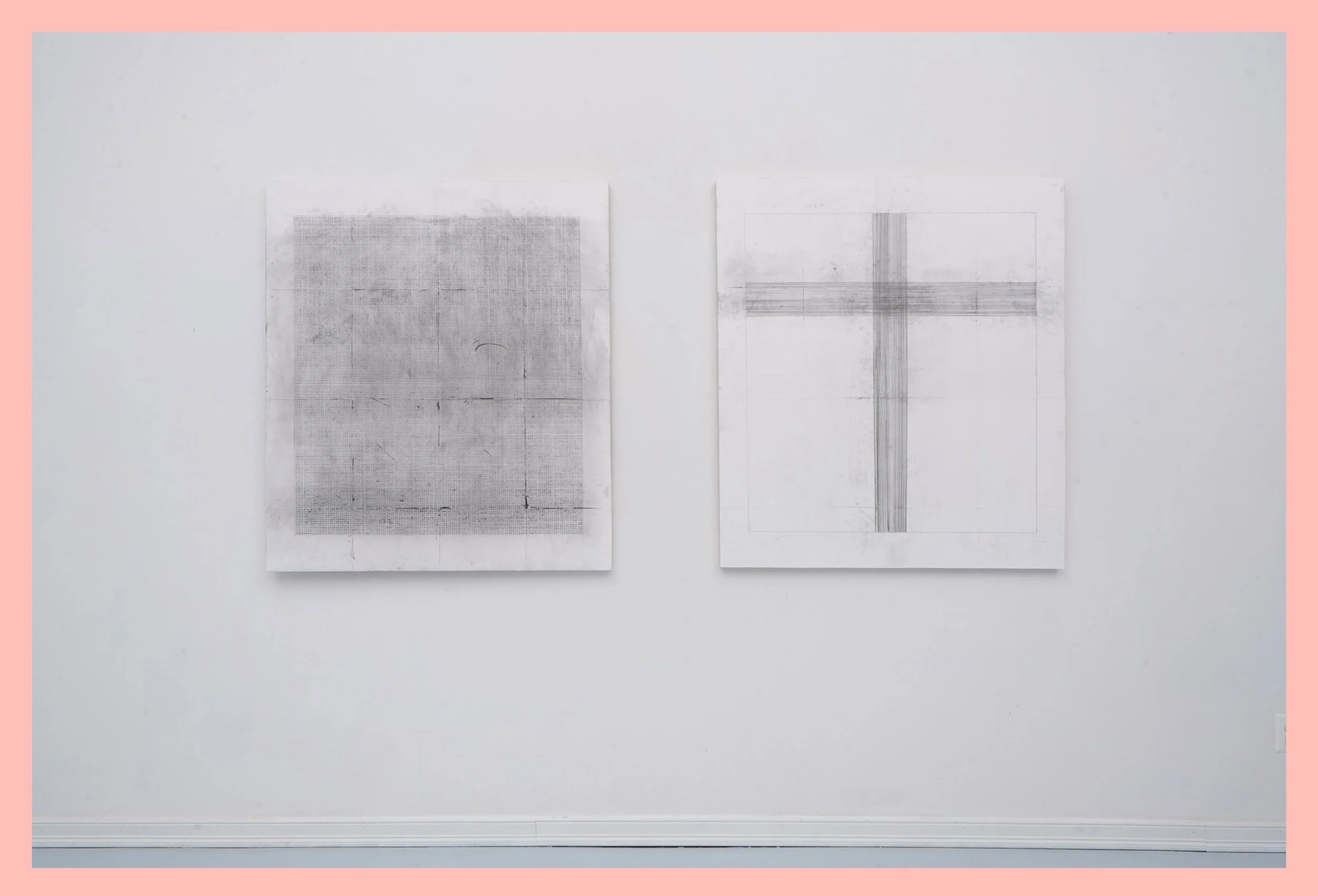
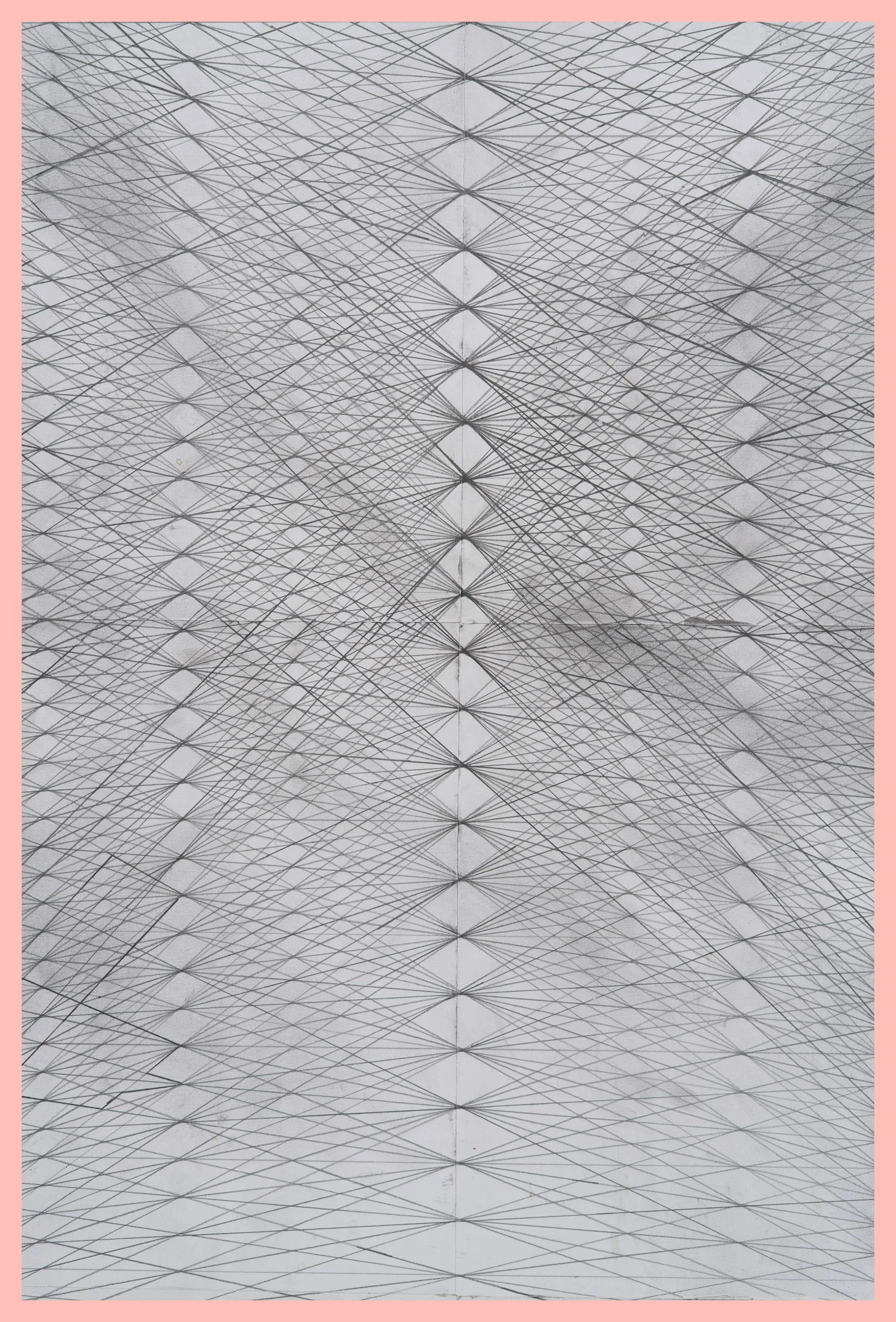
It’s clear from first glance that Brownstein’s drawings are built laboriously, fastidiously, over weeks and months. In this capacity, they exhibit a kinship to textiles – Olga de Amaral’s suspended installations of twine or Lygia Pape’s concept of ‘weaving space’ come to mind, as do Anni Albers’ experiments with form and structure. Untitled(the diegesis) presents graphite linework as if it were warp interlaced with weft, sometimes tightly pulled, occasionally open and spacious, leading us toward the emptiness behind the lines. The gaze shuttles back and forth between regions of varying density, the converging lines producing a perspectival space of vanishing points that leads the eye to burrow deep into the drawing. Untitled(spearmint) plays on the formality of the grid, zooming in closer and closer until it takes on a spiritual dimension.
During the immediate post-pandemic years in which many returned to work, Brownstein continued to dedicate himself to a solitary practice from an open-air studio he constructed in Long Island. He had spent the previous years working sculpturally with heavy raw materials (wood and concrete) and with the subtleties of light (in photograms). Simultaneously, he began reading the essays of French theorist Michel Serres, who is known for his philosophy of the sciences rooted in communication and networks: the interaction and inseparability of all things from cells to stardust. The image of the star recurs throughout Serres’ writing as a symbol of connection, a source of relation. “[Serres] is talking about every point in space as active, radiant, shining upon every other point. That is how the world is built: not as isolated things, but as things radiating, emitting, and affecting everything else.” Brownstein says. “That became important to me with the five-point star.’
In the condensed selection of drawings on view, Brownstein lays out this endless repetition of hand-drawn stars into fields of possibility, spooling boundlessly towards an imagined horizon. They seem to aim at infinity. The artist stenciled over 23,000 stars in total within a single drawing, 21,500 in a second, and continued this quasi-monastic practice of repetition in further drawings of linear webs and intersecting vectors. The stars, webs, and converging bands follow one another across the unadorned, almost ascetic compositional space of tiled sketchbook pages. In the process, they gradually reveal and deepen themselves into a bottomless depth: a sense of the mystic folded within the empirical.
Graphite dust gathers, collects in lines and rivulets along the seams and creases of the sheets of paper. These smudged traces build up into a residue of action, the trace of the hand and the body moving restlessly, fitfully, building up a charged intensity by working the surface with the same repeated mark. As lines and shapes amass themselves, the fragility of the substrate of paper, its slight tears and fragmentation, produces canyon-like gulfs which separate fields of drawn stars and clouds of dust; meanwhile the encircling vacuum of unmarked paper frames the active area of mark-making with a sense of possibility.
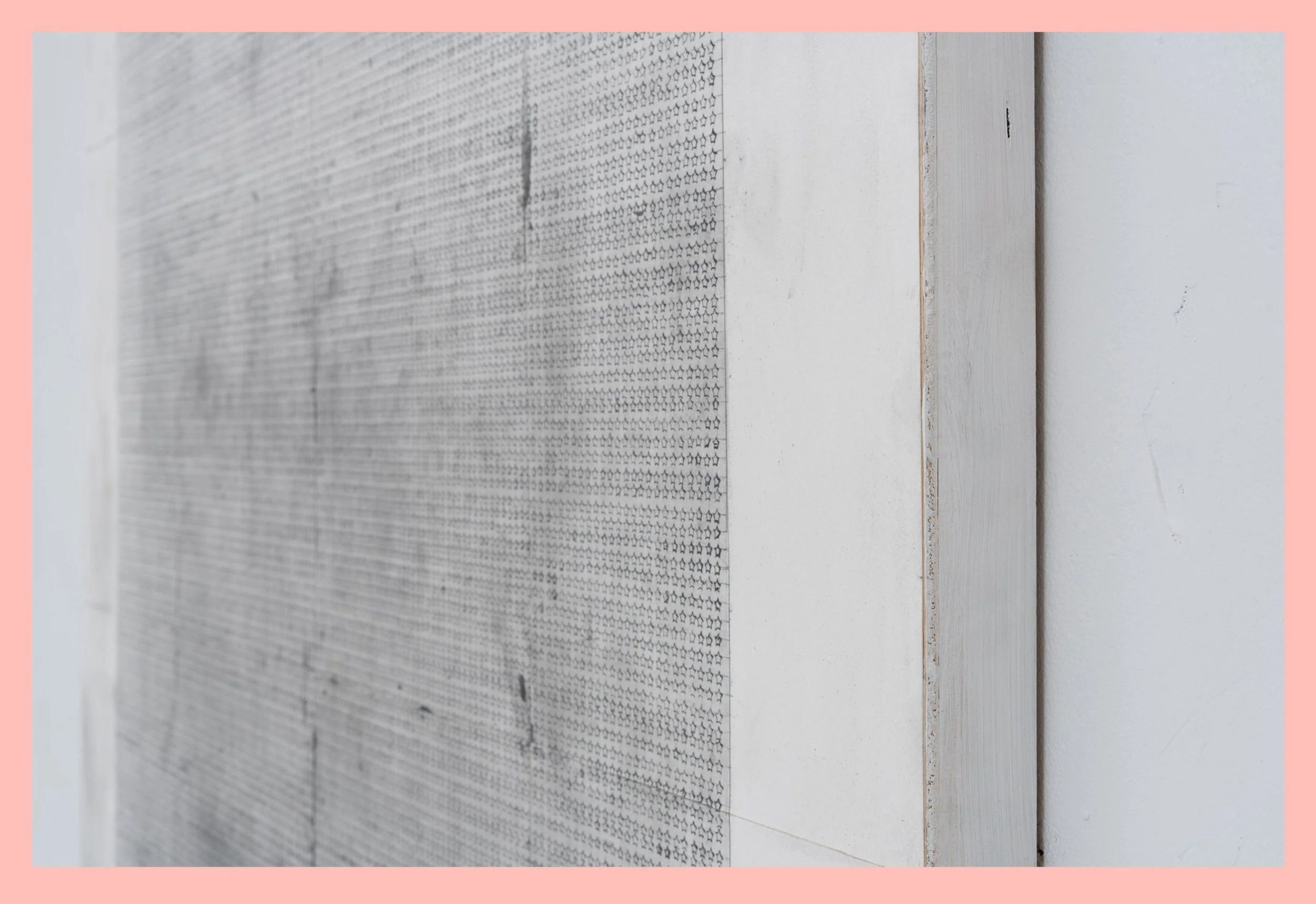
Upon sustained attention, these harmonized traces of dust and matter, collecting en masse, generate a sense of depth and movement, of dynamic shifting space, which draws the eye inward. What ensues is a subtle optical kaleidoscoping, a rudimentary telescope which pulls us in and draws details out of the apparently simple ground of the drawing.
In this empty space behind and between the marks, one discovers a field of activity rife with movement, touch, and interaction. The artistic gesture of making/marking is recorded, moving across the composition like the fiery tail of a comet, leaving an afterimage of its creation. Like looking at a bright light which burns across the room when you turn away, these repeated stars remain present, insistent in the mind. Their image rises up into visibility and persists. As Serres writes:
Space, then, is not empty or neutral. It is the dense fabric of crossing relations,
a network of mutual illumination, where nothing exists in isolation
and everything participates in continuous exchange.
The drawing in its flatness opens itself to the sky as both the heavens and the void. The material of graphite records each action. The accumulation of gestures pulls the fabric of the universe closer as if to inhale it, understand it, unravel its textures — as if to intuit some mechanism behind its order and disorder, divine the unknowable nature of its ever-shifting character. In its ultimate randomness, every point radiates out and affects the next. Every point is a star.
Fascinated by systems of knowledge and belief, Brownstein installed the back of his panels with two sets of hanging hardware, one upright, the other upside-down, so that each drawing could be hung according to two opposite schemes. This reversibility alters the meaning of his symbols — star, cross, weave — which when upright tend towards institutional correctness and an implicit legibility. When seen inverted, they drift toward a darker energy: an ancient, occult, or ritualistic function. Culturally, the inverted star (or pentagram) surfaces in pagan and satanic circles, as does the upside-down cross, although they both have religious subtexts as well. This ambiguity and uncertainty alters our reading of the work. “If you were to hang one upside down in your foyer and see it every day, I think even in a subtle way your emotional position or psychology would be influenced by that darker orientation,” Brownstein muses.
Gnosticism has been one fundamental fulcrum from which Brownstein’s practice operates and its literary influence from Jorge Luis Borges to Thomas Ligotti has imprinted a particular worldview on his philosophical and artistic wanderings. The wonder and disappointment of our reality and its institutions, the emptiness of commonplace axioms and frameworks, the cruelty and randomness of a cosmology overseen by a false Demiurge – these concerns find expression in his searching, questioning, and revelatory sensibility.
In addition to the five drawings on view, Brownstein created a collection of ‘syncretic’ amulets cast in silver solder, handing each amulet out personally and allowing guests to select the one to which they are drawn. This gesture extends his project beyond the individual nature of his drawing practice to imbue the exhibition with a sense of connection and generosity. Once distributed, the collection of amulets will comprise an artwork in which the movement, distribution, and extended network of owners and caretakers are linked together in a pact akin to stars in a constellation. Over time, these amulets will transit different neighborhoods and cities, circulating and finding a life of their own after the show’s closure.
Suffice it to say, this is work which does not produce didactic readings or insist on a set meaning of its own. Rather, it constructs a fictive space in which the eye navigates and finds its own logics, expanding that curiosity and openness to larger conversations of human experience in the universe at large. In doing so, Brownstein takes us near the beginnings of space and time and gives us space to wonder.
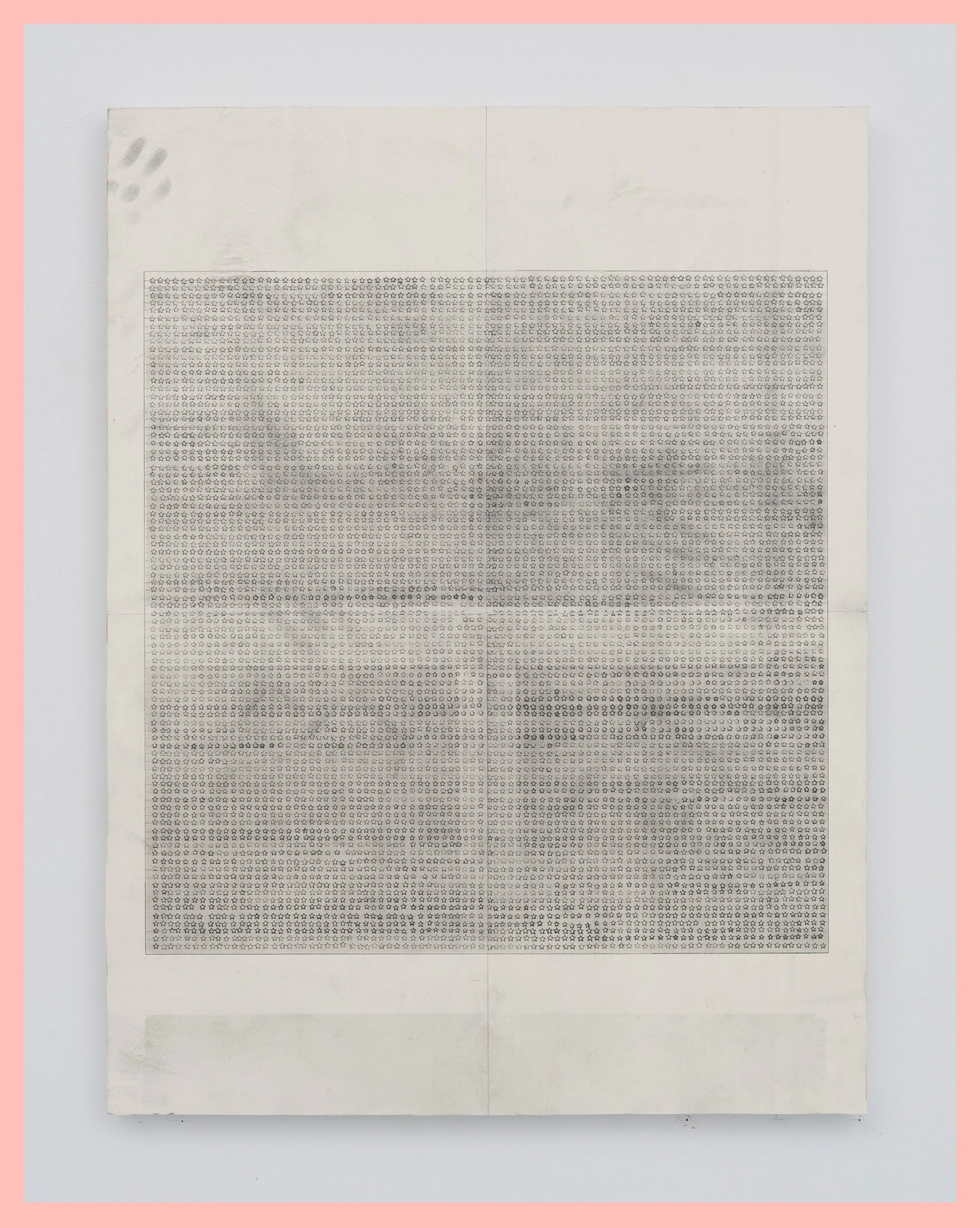
Image captions:
[1] Detail: Evan Brownstein, Untitled(the hole in the heart of the main character), 2026. Graphite on paper
[2] Installation view: Evan Brownstein, Untitled(tell me what you want me to do to you) and Untitled(the diegesis) in Travelogue Hum, Ptolemy
[3] Detail: Evan Brownstein, Untitled(the diegesis), 2026. Graphite on paper
[4] Detail: Evan Brownstein, Untitled(the hole in the heart of the main character), 2026. Graphite on paper
[5] Detail: Evan Brownstein, Untitled(tell me what you want me to do to you), 2026. Graphite on paper
[6] Evan Brownstein, Untitled(to hobble the strawberry roan), 2026. Graphite on paper


